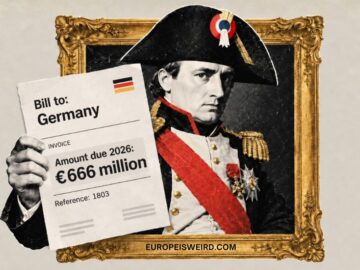
Liechtenstein Outlived the Empire That Created It
In 2007, about 170 Swiss soldiers got lost during a night exercise and marched more than a mile into Liechtenstein. Nobody stopped them. Nobody reported them. Nobody even noticed, which is easier to understand once you know Liechtenstein has no army.
The government found out when Switzerland informed it and apologized. By then, Switzerland had invaded, withdrawn and said sorry before Liechtenstein had managed to participate in its own international incident.
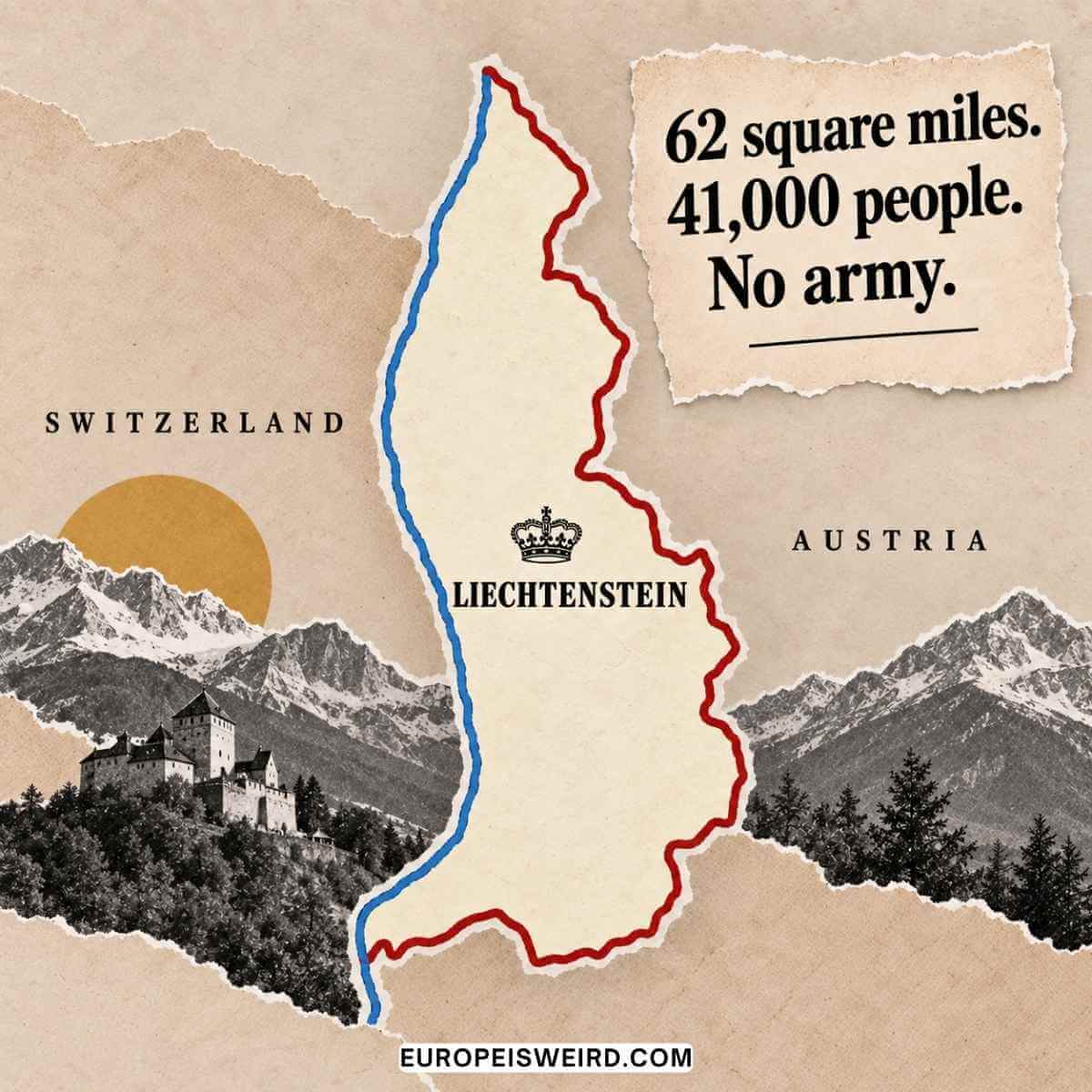
Liechtenstein has survived without a military since 1868, and that is somehow only the second-strangest thing about it. The strangest is why the country exists at all: one very rich family wanted a seat in a meeting, couldn’t get one, and bought the paperwork instead.
Rich, titled, and short one piece of land
The Imperial Diet was where the Holy Roman Empire's rulers voted on war, taxes and law. Getting in was the line between having money and being somebody, and by the 1690s the House of Liechtenstein was stuck on the wrong side of it.
They had castles, princely rank, court connections and huge estates across Moravia and Bohemia. What they didn’t have was a single piece of land held directly from the emperor.
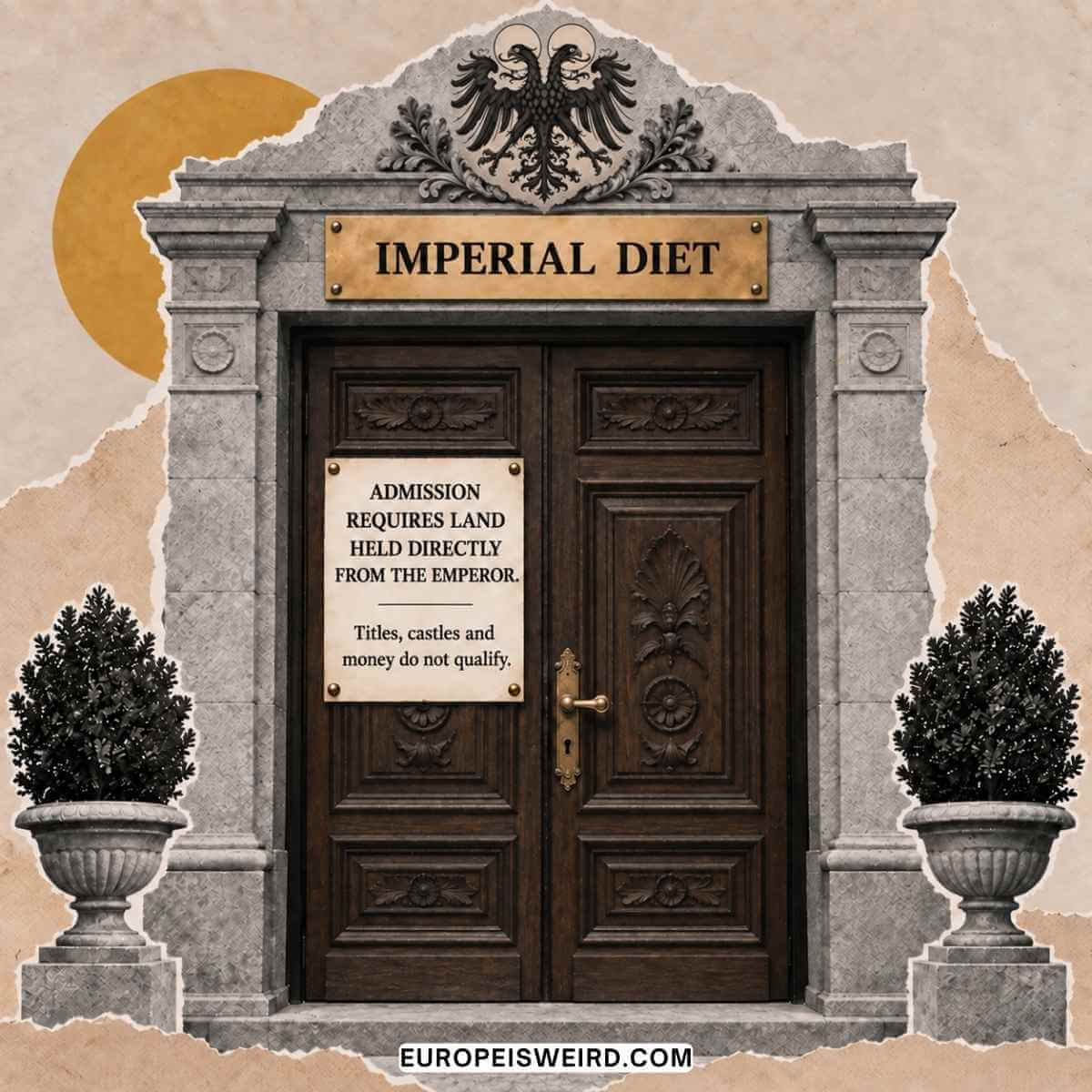
Their existing estates answered to the Habsburgs in their capacities as kings and dukes, which didn’t qualify the family for the imperial seat it wanted.
So there were Princes of Liechtenstein, and there was no country called Liechtenstein. Great title, no address.
Two bankrupt territories, one very motivated buyer
Since the land couldn't be inherited into existence, the family went shopping for it, and two small territories on the Rhine happened to be available. Schellenberg and Vaduz belonged to the Counts of Hohenems, who were spectacularly broke.
Part of how they got that way is grim. Ferdinand Karl von Hohenems presided over witch trials that killed 45 people in 1679–1680, while his finances collapsed.
Around 200 death sentences are documented across several waves of persecution, in territories holding only a few thousand people.
By then, even the income from fines and confiscations had been pledged to repay debts. The emperor banned further trials, ordered an investigation and eventually had Ferdinand Karl removed. The debts stayed.
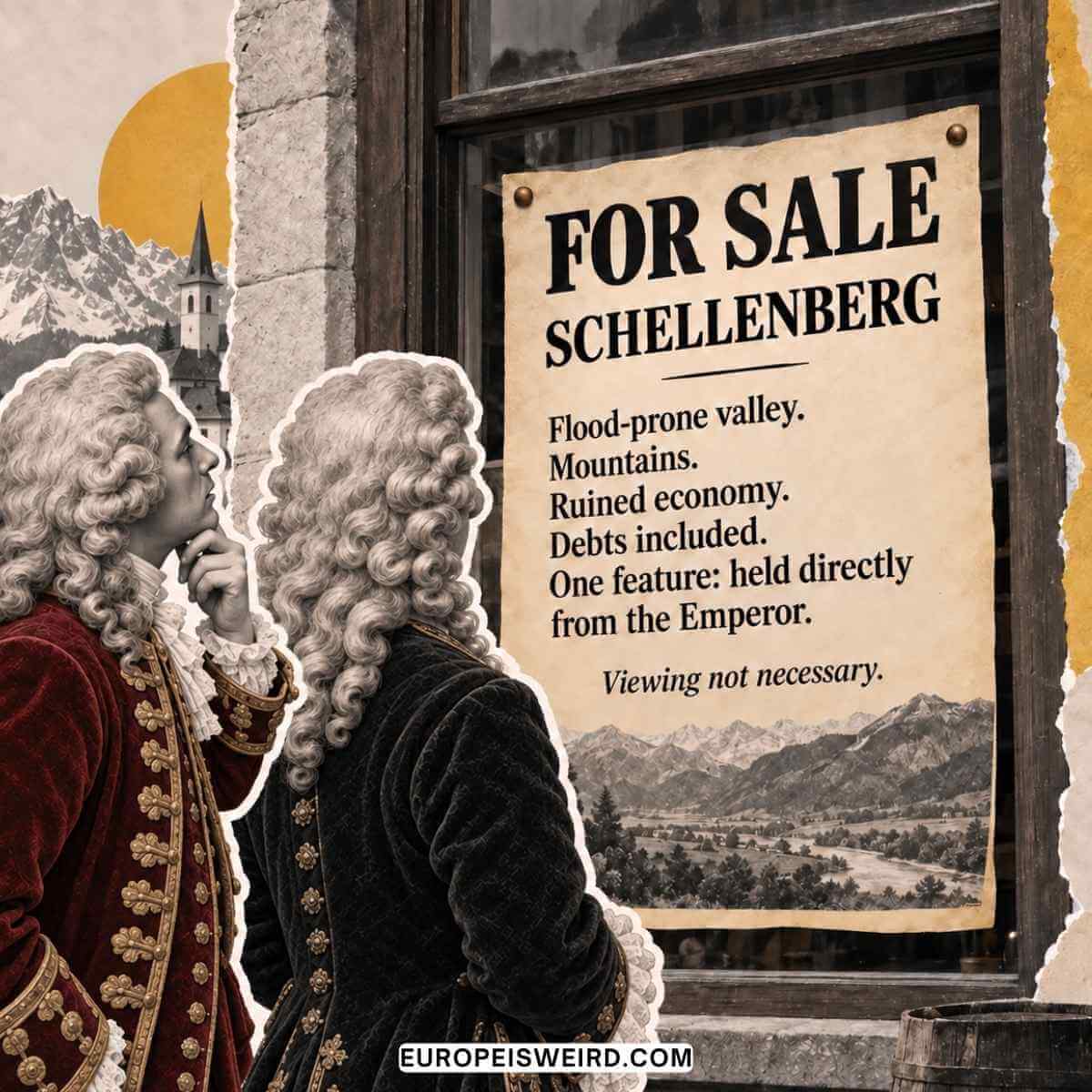
What went on the market was a flood-prone valley and its surrounding mountains, with a wrecked economy, a traumatized population and one asset the Liechtensteins actually needed: it was held directly from the emperor.
405,000 guilders for a country nobody in the family bothered to visit
Prince Johann Adam Andreas bought Schellenberg in 1699 for 115,000 guilders, substantially above its estimated value. Schellenberg alone, however, didn’t get him the imperial seat.
In 1707, he also provided a 250,000-guilder interest-free loan to the Swabian Circle, a regional grouping within the empire. That secured a place on its princes’ bench. Different meeting. Still expensive.
Vaduz followed in 1712, for another 290,000 guilders. The two purchase prices added up to 405,000 guilders for 62 square miles of Rhine valley and Alpine mountains.
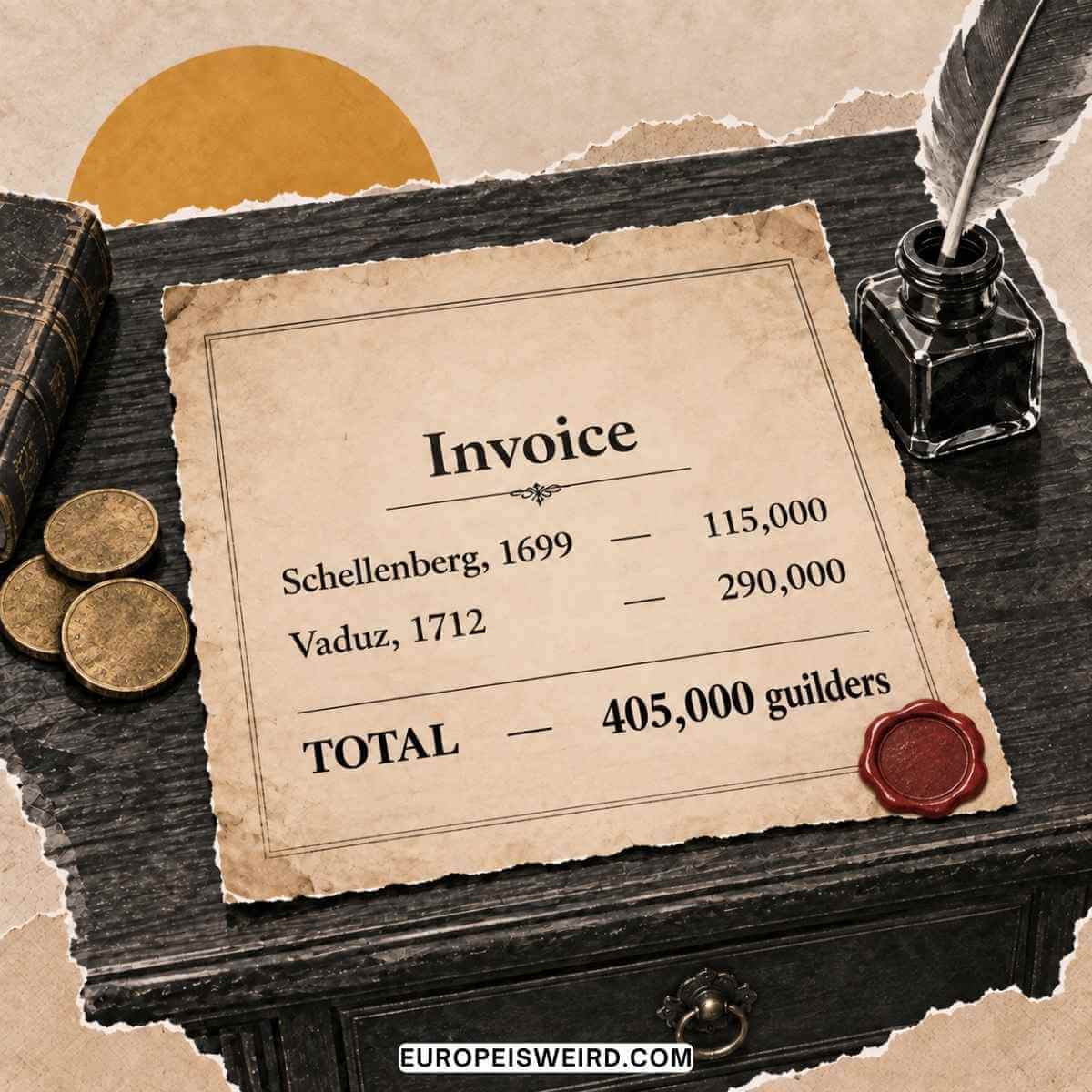
The loan was extra. Johann was buying political eligibility, and the future country came with it.
It worked, just not in time for Johann. His cousin Anton Florian secured a personal seat in the imperial princes’ council in 1713, and in 1719 Emperor Charles VI merged Schellenberg and Vaduz into the Principality of Liechtenstein.
Formal admission for the dynasty followed in 1723, under Anton Florian’s son. Johann had died in 1712, without ever seeing either half of the very expensive solution.
Then Napoleon deletes the empire
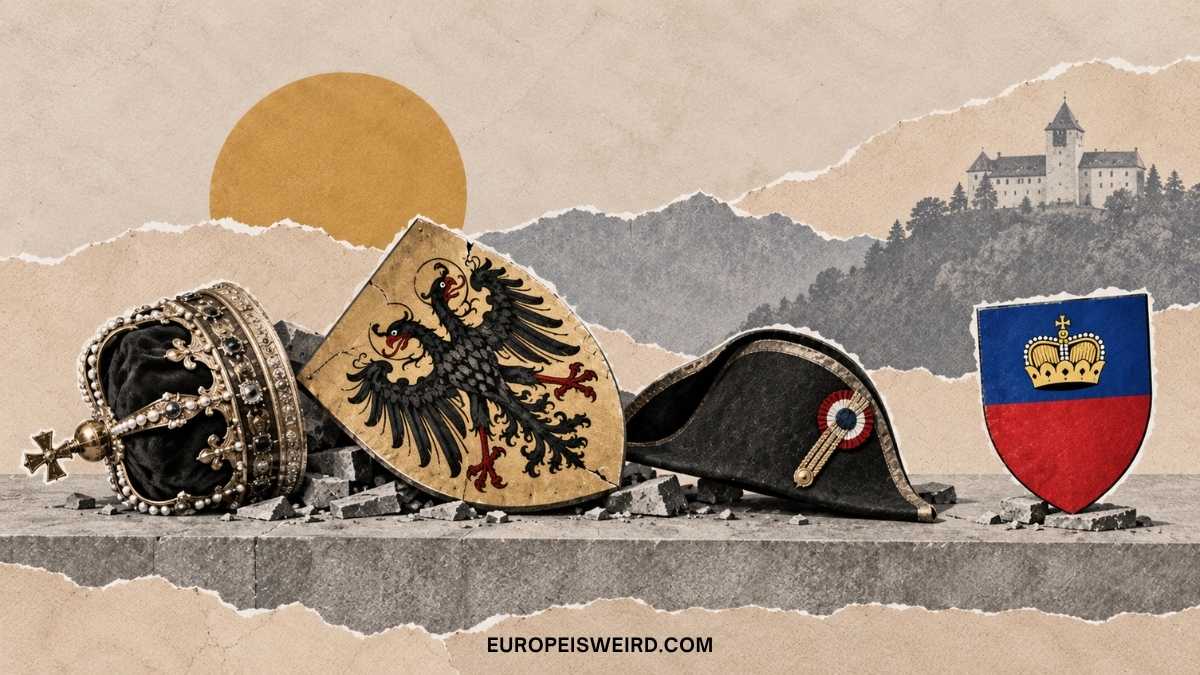
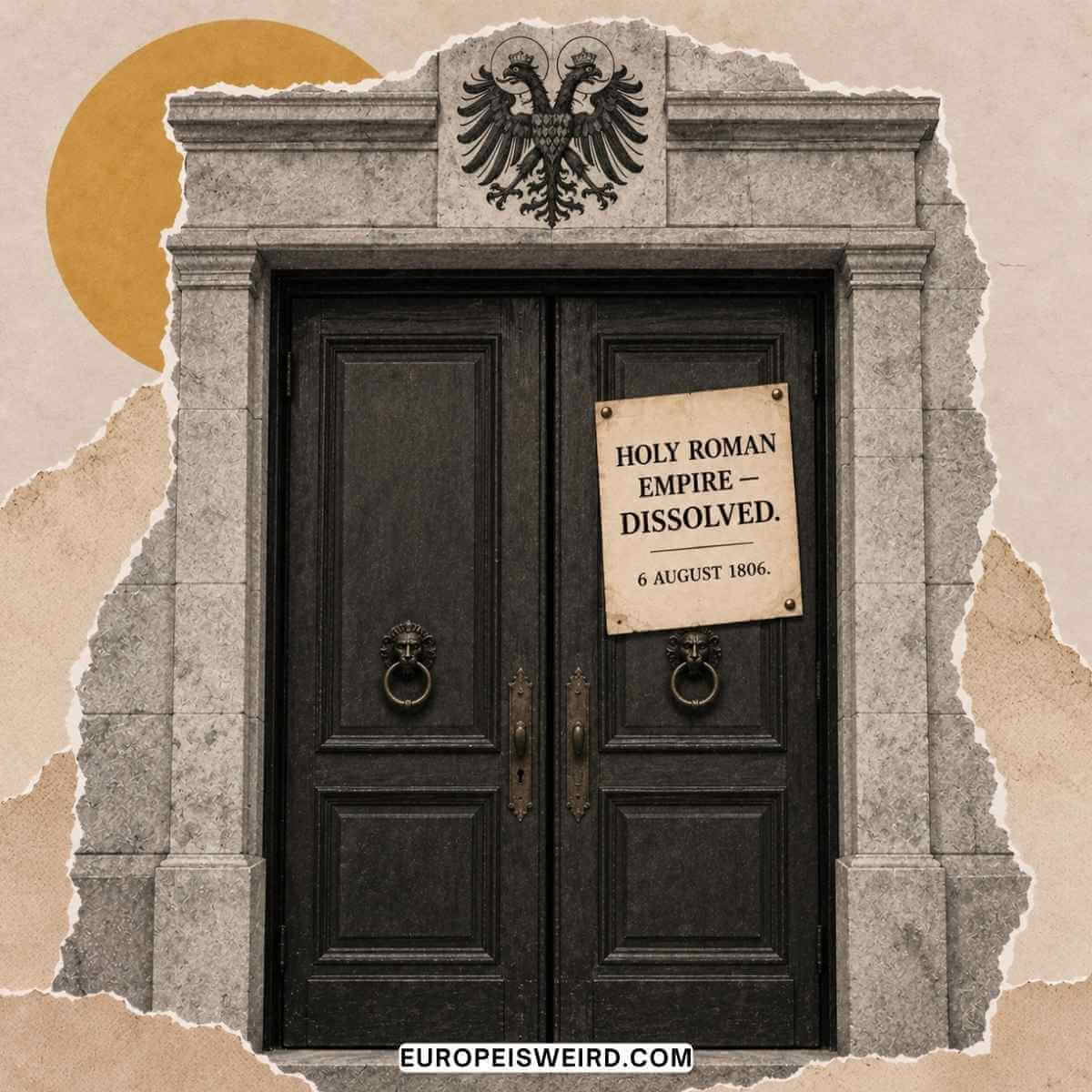
In 1806, Liechtenstein became sovereign through Napoleon’s Confederation of the Rhine. Its founding treaty was dated July 12. On August 6, twenty-five days later, Francis II dissolved the Holy Roman Empire.
The Liechtensteins had spent generations buying their way into the empire and more than eighty years enjoying the seat. Then the meeting disappeared, followed by the entire empire. They had paid for membership and somehow walked away with a country.
The reason Liechtenstein survived Napoleon is even better. He was busy erasing small German states from the map, but Prince Johann I happened to be an Austrian general who had helped negotiate the peace after Austerlitz and earned Napoleon’s respect.
So Napoleon included Liechtenstein in the Confederation partly as a favor to Johann, hoping to win over an influential Austrian.
The prince never signed the founding document and never formally declared his withdrawal from the empire. He was basically handed sovereignty by the man demolishing the system his family had spent a fortune trying to join.
After that, Liechtenstein kept surviving other people’s collapses.
The Confederation of the Rhine fell apart in 1813. The Congress of Vienna confirmed Liechtenstein’s sovereignty in 1815, and the country joined the German Confederation. That collapsed in 1866. Liechtenstein, once again, did not.
That final collapse also ended its obligation to maintain troops, and 1866 had already made a strong case for giving up. Liechtenstein sent a contingent of about eighty men to guard the Austrian border near the Stelvio Pass against Italy.
They saw no fighting, took no losses, and are remembered almost entirely for how they came home. The popular version says eighty went out and eighty-one came back, having picked up an Italian friend along the way.
The records point to something less quirky. The eighty-first man was an Austrian lieutenant named Radinger, and the commander had already written to his wife asking her to prepare the guest room. The army's one campaign ended with it bringing home a houseguest
Two years later, Liechtenstein disbanded the army for good, on the grounds that it was expensive and had nothing left to do.
Two centuries of living somewhere else
None of this made the family rush to move in. The future Prince Alois II visited in 1818, but no reigning prince set foot in Liechtenstein until he returned in 1842 - 123 years after the principality was created.
The princes preferred Vienna and their Moravian estates, which were bigger, richer and much closer to the life they actually cared about.
That changed in 1938. Nazi Germany annexed Austria, Franz Josef II moved to Vaduz and became the first reigning prince to make Liechtenstein his permanent home. It had taken the family 219 years to move into the country it ruled.
The Wehrmacht was a persuasive argument for a change of address.
Then Czechoslovakia took the estates
Seven years later, the Czech estates were gone. In 1945, Czechoslovakia confiscated the family’s remaining property there, including around 69,000 hectares belonging to the reigning prince - more than four times the size of Liechtenstein itself.
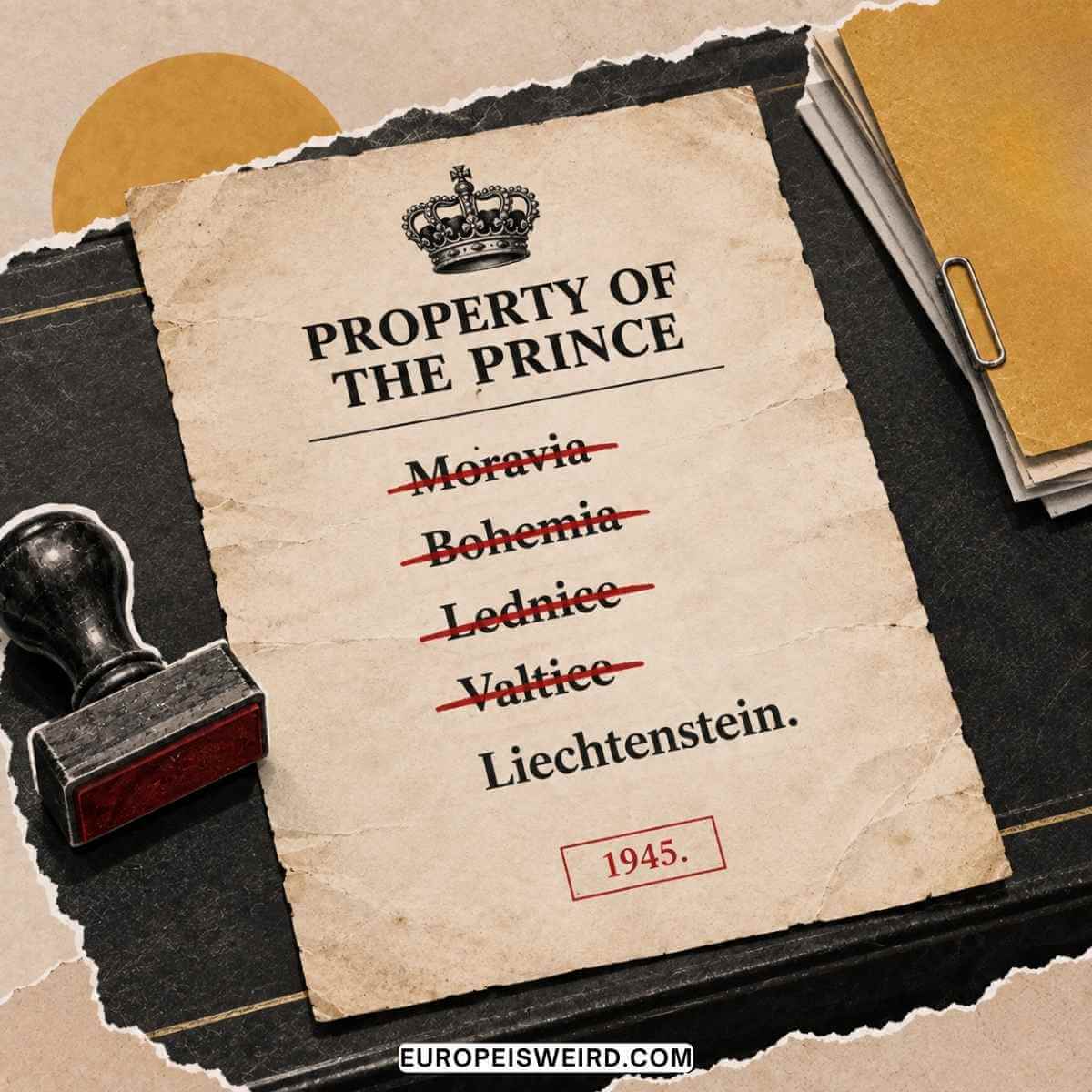
A huge chunk of centuries-old family wealth disappeared in one move, and the Liechtensteins are still fighting over it in court.
They still owned other assets, including palaces in Vienna. But the tiny principality now had one very useful advantage: it was a sovereign state where they remained the ruling family. The Czech estates were gone. Liechtenstein suddenly looked like the better investment.
The landlords have opinions
The family remains extremely interested in running the place. The prince can veto laws, dismiss the government and influence judicial appointments, and twice the family has warned voters what might happen if a constitutional vote went the wrong way.
In 2003, Hans-Adam II proposed expanding his authority and suggested the family might move back to Vienna if voters said no. The changes passed with 64.3 percent.
In 2012, a referendum tried to remove the prince’s veto over laws approved by popular vote. Crown Prince Alois said the family would withdraw from politics if it passed. Instead, 76.4 percent voted against the proposal.
In most European monarchies, “the prince will stop interfering in politics” sounds like the reform. In Liechtenstein, it works as a threat.
Everyone else keeps an exit too. Voters can abolish the monarchy through a constitutional referendum process, while any of the eleven municipalities can vote to begin leaving the country, with departure settled by law or treaty. Both routes are written into the constitution.
The empire collapsed. The country got rich.
The ruined little valley is now filthy rich. Around 41,000 people live in 62 square miles between Switzerland and Austria, using Swiss francs in one of the world’s richest countries per person.
Banks manage fortunes, factories make precision tools, and there are more jobs than residents, so Liechtenstein imports more than half its workforce every morning.
Of course it ended up in wealth management. The entire country started as a rich man’s paperwork problem.
Johann Adam Andreas overpaid for two battered territories to satisfy an imperial rule, never visited them and died before they were even turned into a principality.
His purchase outlasted the empire he bought it to enter, outlasted Napoleon, outlasted the Habsburg monarchy and left his family with a throne long after the meeting was canceled.